
Buying a first piece of pearl jewelry

Buying a first piece of pearl jewelry
Pearls are the one material in the case that was alive. That single fact explains most of what follows: why they vary, why they are graded the way they are, and why they need looking after differently from everything else on the shelf.
The four types you will actually meet
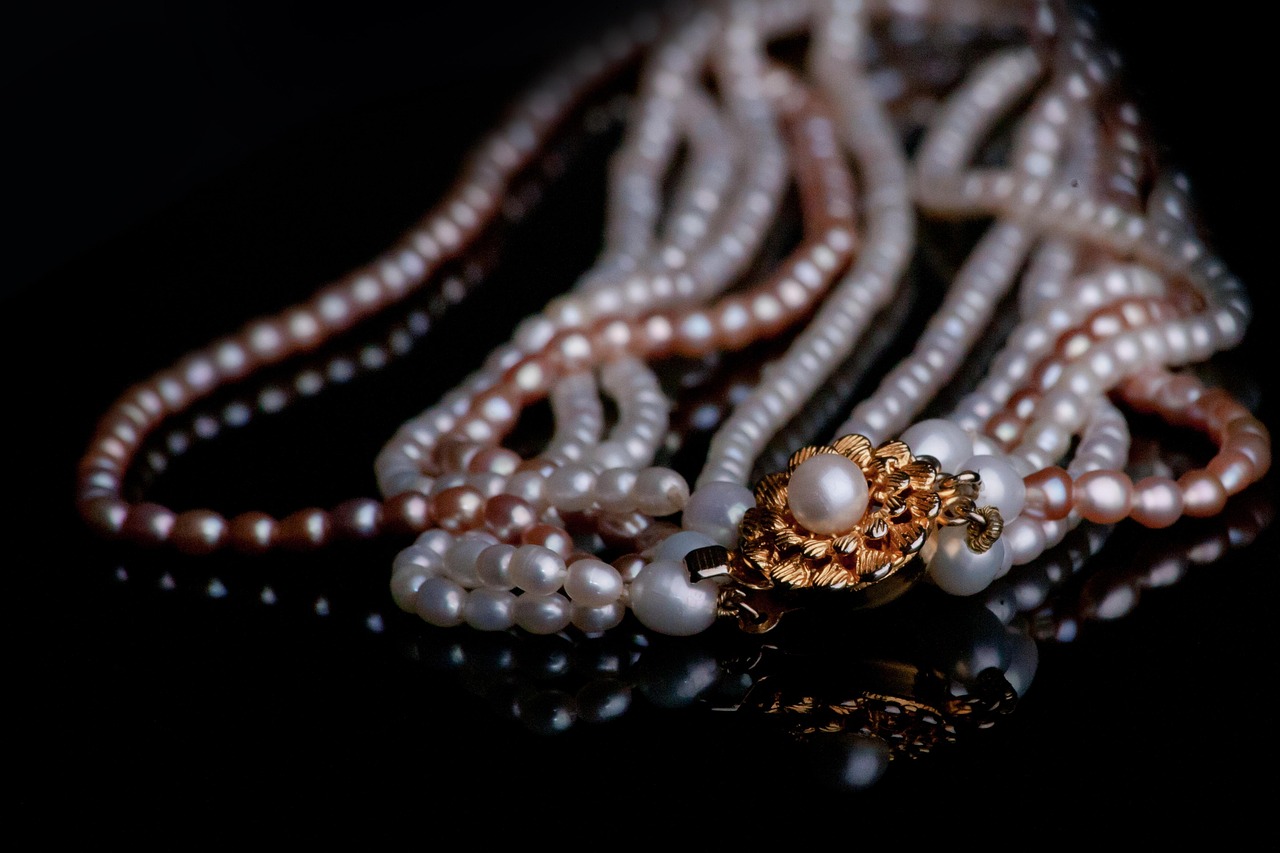
Freshwater pearls are grown in mussels, mostly in China, and account for the overwhelming majority of pearl jewelry sold. They come in white, cream, pink and lavender, in every shape from round to baroque, and they are the reason a pearl necklace can cost less than dinner.
Akoya pearls are saltwater, grown in Japan and China, and are the classic small round white pearl with the sharp mirror-like surface. Rounder and more uniform than freshwater, and priced accordingly.
Tahitian pearls are saltwater, naturally dark — grey, green, aubergine, peacock — and larger. Genuinely dark pearls are not dyed, which is why they cost what they do.
South Sea pearls are the largest, white or golden, and are the expensive end of the market.
The pieces on this site are freshwater and Tahitian. Where a listing says Tahitian, that is the manufacturer’s description of a naturally coloured saltwater pearl.
What actually decides the price
Five things, roughly in order of how much they move the number.
- Lustre — how sharply the surface reflects. Hold a pearl near a window: on a high-lustre pearl you can almost make out the shape of the window frame. This matters more than everything else combined, and it is what makes a pearl look like a pearl rather than a bead.
- Shape — perfectly round is rare and priced for it. Near-round, oval, drop and baroque descend in price and, in the case of baroque, not in appeal.
- Surface — pearls grow with small marks. Fewer marks costs more; a pearl with no marks at all is worth a second look.
- Size — measured in millimetres. Six to seven is ordinary, eight to nine is noticeably larger, and price rises steeply above that.
- Colour — natural colour costs more than dyed. Dyeing is normal, legitimate and should be disclosed.
Real, cultured and imitation
Almost every pearl sold today is cultured: a real pearl, grown in a real mollusc, started deliberately by a farmer rather than by accident. Cultured is not a lesser category, it is the entire modern industry. Natural pearls — formed with no human involvement — are essentially an antique market.
Imitation pearls are glass or plastic beads with a coating. They are perfectly reasonable costume jewelry and must be described as imitation, faux or simulated.
The old test still works: run the pearl gently along the biting edge of your front tooth. A real pearl feels slightly gritty, because its surface is layered crystal. An imitation feels glassy and smooth. It is not a laboratory test, but it separates the two categories reliably.
Strand length, and one thing to check
Pearl strands use their own vocabulary: collar sits on the neck, choker at its base, princess is the common 17–19 inch length, matinee falls to the chest, opera longer still. Princess is the default for a first strand and works with most necklines.
The thing to check is knotting. A well-made strand has a knot between each pearl. It stops the pearls rubbing, and if the thread breaks you lose one pearl rather than all of them. Where a maker states knotting, we repeat it.
Caring for pearls
Two rules cover almost everything.
Last on, first off. Pearls go on after perfume, hairspray, makeup and lotion, and come off before anything else. Cosmetics and hair products dull nacre permanently.
Wipe and lay flat. A soft dry cloth after wearing. Never soak a strung strand — water travels along the silk thread, stretches it and cannot be dried out of it.
Store pearls in a soft pouch, not a sealed plastic bag. Nacre holds a small amount of moisture and drying it out completely makes it brittle. Keep them away from other jewelry, because they are soft and everything else in a jewelry box will scratch them.
A strand worn often should be restrung every year or two. You can see when it is due: the thread darkens and gaps open between the pearls.
Buying pearls as a gift
Pearls are unusually safe as a present because they suit almost everyone and carry no sizing risk on a necklace. If you are unsure, a princess-length freshwater strand or a single pearl pendant is the answer that has worked for a century.
Where a gift box is supplied by the maker, the listing says so, and the pouch matters here more than with metal — it is where the pearls should live between wearings anyway.
Where the pearl pieces are
Everything pearl on this site sits under pearl and moissanite necklaces, alongside the moissanite pendants — the two are grouped because both are the dressier end of the case rather than because they are alike.
For something plainer to wear alongside, the everyday pendant necklaces layer well under a shorter strand, and the bracelets and bangles page covers the wrist. If you want to see a pearl’s lustre before deciding, the case is at the counter during opening hours.